Carbon
80
Analog soul
Digital control
A software synthesizer built on a model of the analog signal path. Oscillators, filters, amplifiers and envelopes are computed as a circuit model; modern control, modulation, effects and wavetables sit on top.
In development · not yet available to download
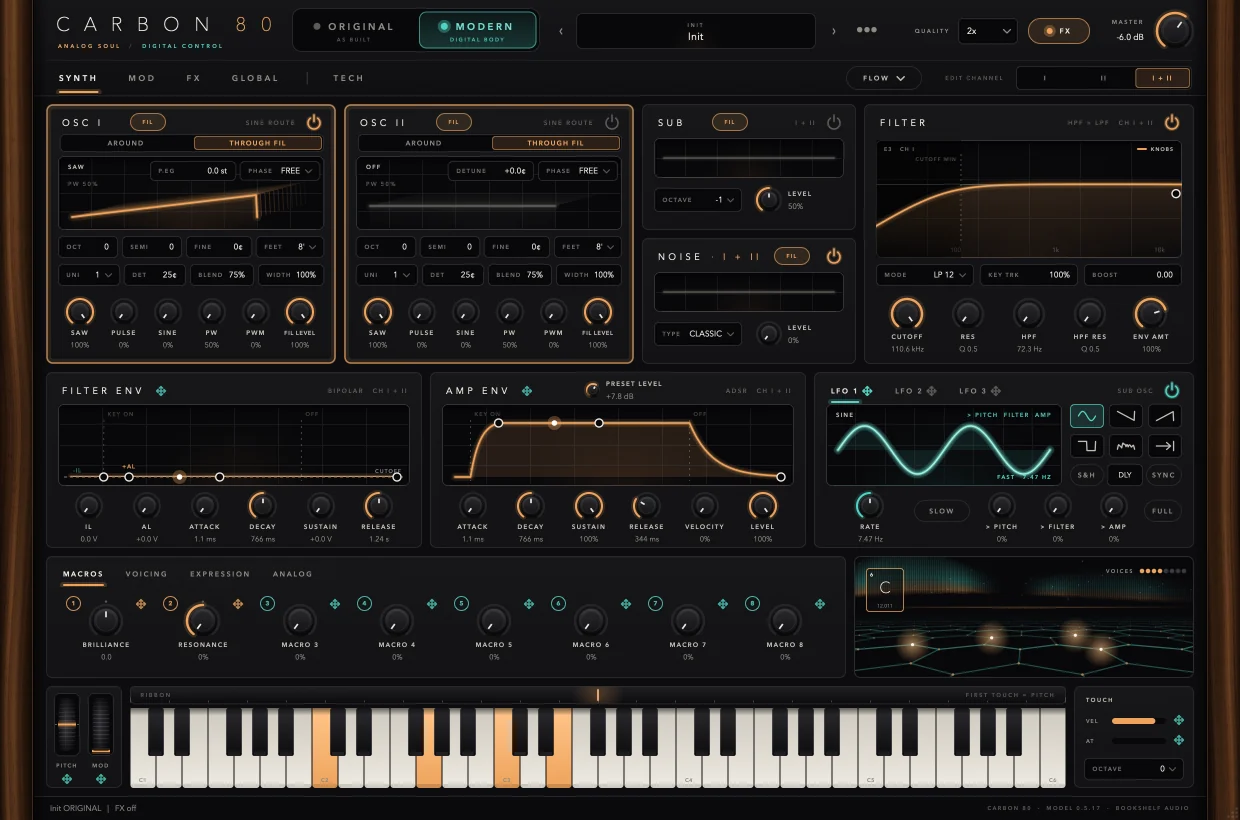
The real plug-in. Controls moved by hand.
As it was built. And what it can become today.
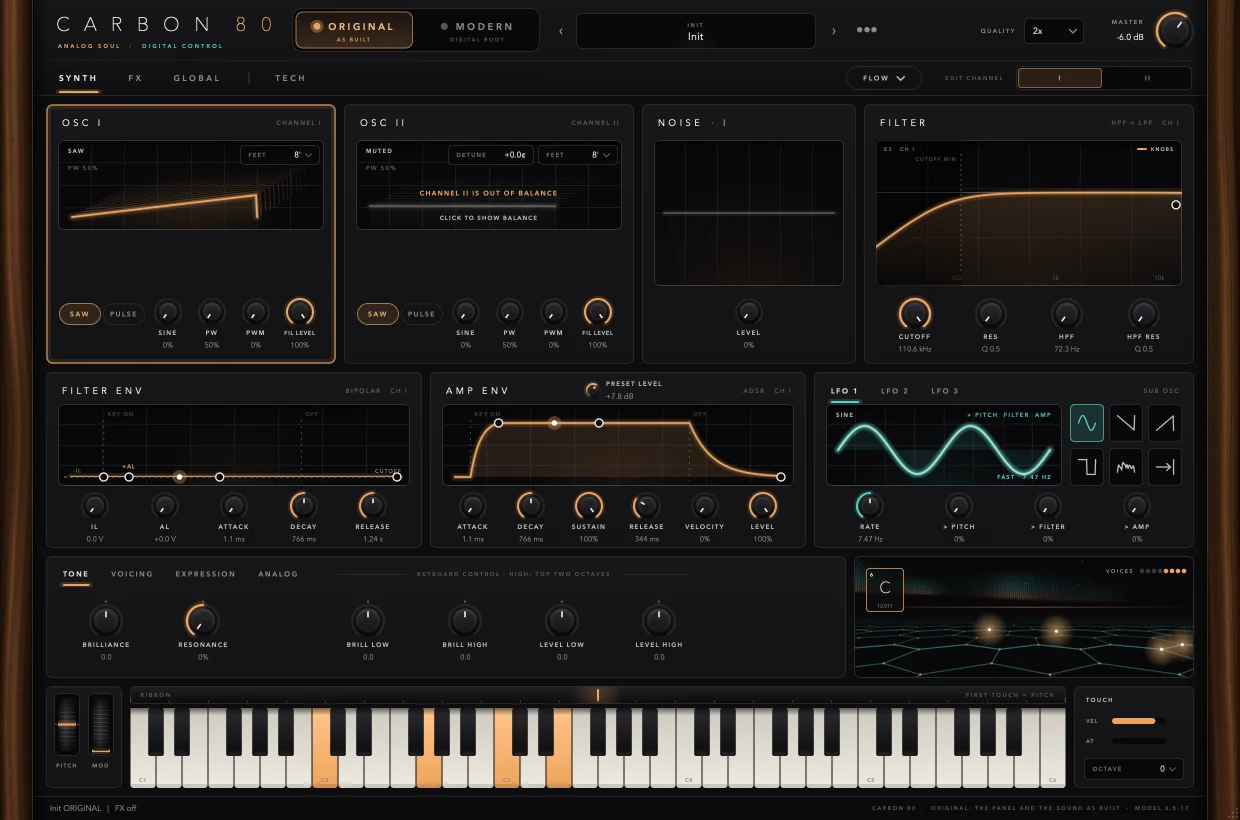
The reference configuration with the original controls. Modern extensions are neutralised — the instrument as it was designed.
Modern sources, modulation, extra signal routing, unison and effects. Switch back to ORIGINAL and your MODERN settings wait for you.
A circuit, not a recording.
Eight voices, two channels each. Every channel has an oscillator, a waveshaper, high- and low-pass filters, an amplifier and envelopes. Their structure and values follow schematics, service documentation and factory calibration procedures.
All synthesis happens in digital DSP. “Analog signal path” means a model of how the circuit behaves — not analog electronics inside the plug-in. Where the documentation is silent, the assumption is written down.
- 01VCO I / II
- 02Waveshaper
- 03HPF
- 04LPF
- 05VCA · ENV
- 06Ring · chorus
- →Out
| Node | What you hear |
|---|---|
| Oscillator | The character of the raw waveforms and how they respond to control |
| Filters | Resonance, saturation and a dynamic response to the signal, from non-linear cells |
| Amps & envelopes | Attack, decay — and how the timbre moves with the envelope |
| Shared path | Channels interacting, ring modulation, chorus and tremolo on a bucket-brigade model |
No two analog instruments are alike.
Component tolerance, residual calibration, warm-up, drift, age and condition are parameters of the model. The same instance number always reproduces the same combination of deviations.
In MODERN, BENCH goes further: saw shape, pulse symmetry, filter asymmetry, VCA leakage, envelope curvature and supply sag.
- CALIBRATION
- WARM-UP
- DRIFT
- TOLERANCE
- AGE
- CONDITION
A digital source inside an analog path.
Channels I and II each choose ANALOG or WAVETABLE. The table replaces the channel's saw and pulse; everything after — filters, saturation, feedback, amplifiers, envelopes — is the same modelled path.
POSITIONMORPH A/BSIZEHOLLOWLIFESPREADXY PAD
original tables
wavetable presets
modulation matrix slots, assigned by drag, with VIA and curves
effect slots — bucket-brigade ensemble and echo, poly filter, compressor, frequency shifter and more
LFOs, three of them drawable, plus envelopes three and four
morph between two panel snapshots; macros, arpeggiator with chord and scale, MIDI learn
The models rest on schematics, service documentation and established methods of digital synthesis. The platform's research library holds more than two thousand pages and scanned sheets.
Names of historical instruments appear in our technical material as research references only and imply no affiliation with their manufacturers.